Lycopus vs Ajuga Bugleweed Tincture: Are These Drops Made From the Same Plant?
Пост обновлен 25.09.2026
Автор статьи: Daniyar Abdi
Lycopus vs ajuga bugleweed tincture is an identity question first. Both plants can appear under the common name bugleweed, but they belong to different botanical genera. This guide shows you how to read a product label, compare living-plant photos, and ask for the missing detail when a bottle names only a genus.
The HerbEra bugleweed tincture description identifies its botanical as Lycopus spp. That identifies the genus, not one confirmed species, and it does not identify the product as Ajuga reptans. Keeping those distinctions clear is the editorial starting point for this comparison.
Are Lycopus and Ajuga the same bugleweed?
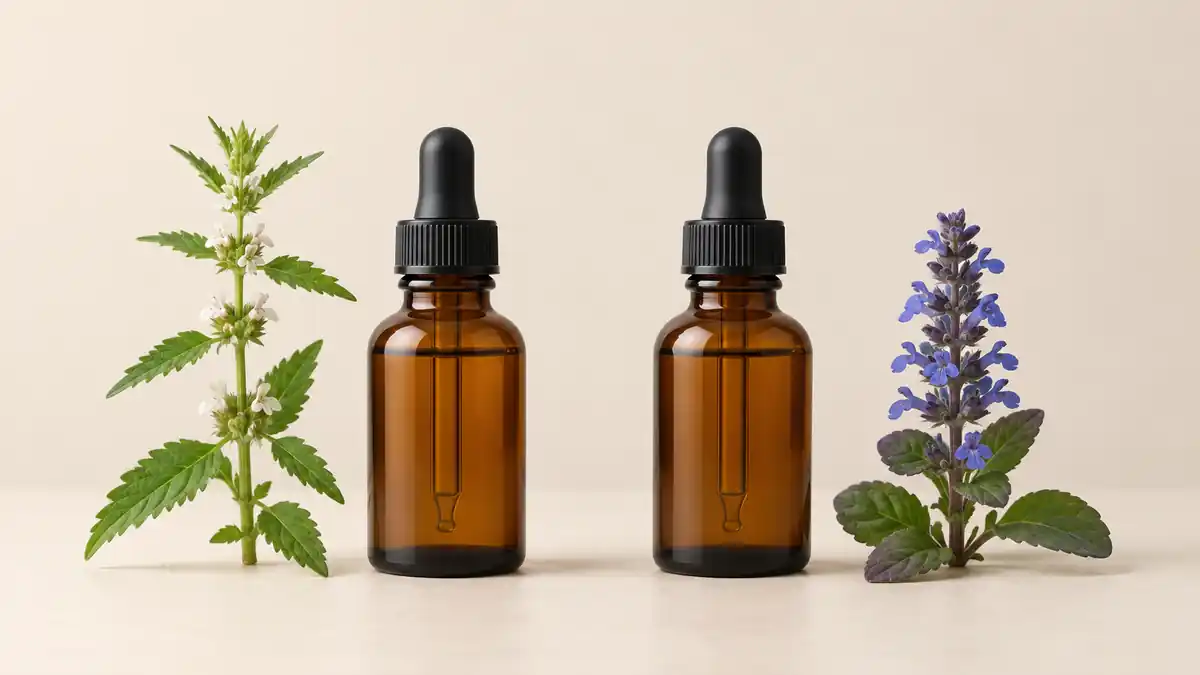
No. Lycopus and Ajuga are separate genera in the mint family, Lamiaceae. A name shared by two plants does not make their ingredients, extracts, or labels interchangeable.
Lycopus includes species such as Lycopus virginicus, Lycopus americanus, and Lycopus europaeus. Ajuga reptans is another plant also called bugleweed, blue bugle, or carpet bugle. The exact scientific name is therefore more useful than the word bugleweed on the front of a bottle.
| Identity check | Lycopus bugleweed | Ajuga bugleweed |
|---|---|---|
| Botanical genus | Lycopus | Ajuga |
| Species you may encounter | L. virginicus, L. americanus, or L. europaeus | A. reptans is a common example |
| Other common names | Names vary by species and may include water horehound or gipsywort | Blue bugle, carpet bugle, or carpet bugleweed |
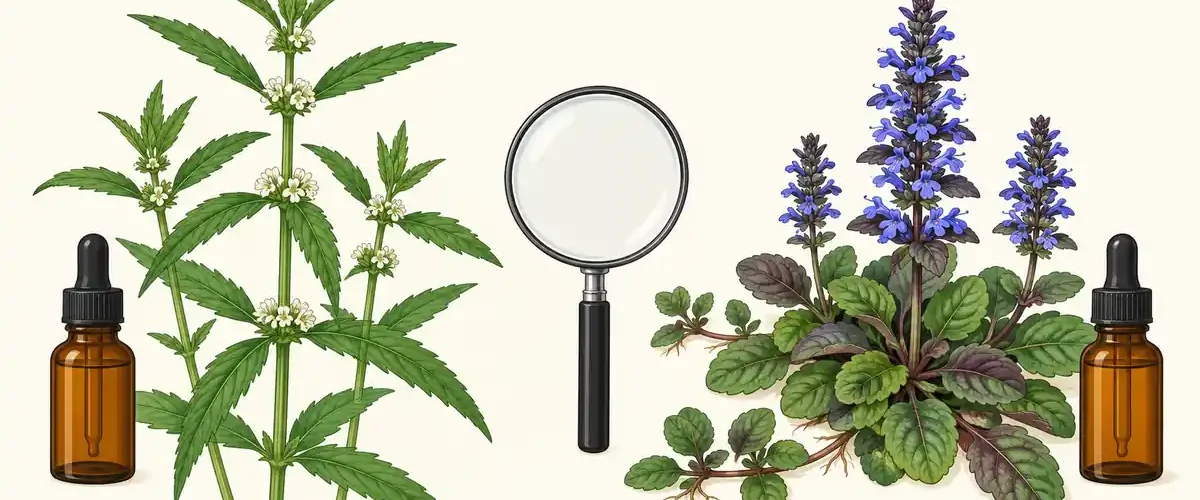
| Typical living-plant appearance | Upright stems with small flowers grouped near leaf joints | A low, spreading mat with upright spikes of blue-violet flowers |
| Forms a shopper may see | Liquid extracts, dried herb, and other botanical products | Live ground-cover plants and products labeled as Ajuga drops or tinctures |
| What the common name proves | Nothing about the exact species without more information | Nothing about the exact species without more information |
The table compares names and visible plant traits, not the quality of any particular product. A finished liquid extract rarely retains features that let a buyer identify the original plant by sight.
What does Lycopus spp. tell you?
Lycopus spp. means the product is described at the genus level. The abbreviation refers to species within that genus but does not tell you which species a particular bottle contains. It also does not establish that multiple species were blended.
That distinction matters when comparing products. One label might specify Lycopus virginicus. Another might specify Lycopus europaeus. A third might say only Lycopus spp. These labels provide different levels of botanical detail, even if all three use the word bugleweed.
For HerbEra and any other seller, the editorial standard here is the same: a genus-level bugleweed tincture listing should not be rewritten as a specific species without confirmation from the manufacturer. A buyer who needs a particular species should request its full botanical name for the product lot under consideration.
Genus is not species
The first word of a botanical name identifies the genus. A second word, such as virginicus or reptans, identifies the species. The names Lycopus virginicus and Ajuga reptans therefore describe different plants, despite their shared common name.
Plant part is a separate detail
After confirming the botanical name, check which part was used. A label may say leaf, flowering tops, or aerial parts. These terms describe the material placed into a preparation; they do not resolve a missing species name.
Can photos help distinguish the plants?
Yes, photos of intact, identified plants can help you recognize the difference between typical Lycopus and Ajuga reptans. They cannot, by themselves, confirm what a commercial bottle contains.
Look at the growth habit
Ajuga reptans usually spreads close to the ground and forms a dense mat. Its flowering stems rise above the foliage. In contrast, representative Lycopus plants have more upright leafy stems and are often associated with damp sites.
Look at where the flowers sit
Ajuga reptans is known for conspicuous spikes of blue-violet flowers. Flowers on Lycopus are typically much smaller and occur in clusters around the stem near the leaves. Color and shape can vary across species and growing conditions, so use several features together.
Use identified plant photos, not packaging art
A botanical-garden or extension photograph with a scientific name is more useful for learning than a decorative image on a supplement listing. Bottle artwork, stock photos, and the color of the liquid do not authenticate the contents. When possible, compare photos of the whole plant, leaves, stems, and flowers rather than one close-up.
Which parts of a tincture label should you check?
Check the botanical name first, then the plant part and preparation details. This order keeps an attractive format or familiar common name from hiding an identity mismatch.
Read beyond the product title
The title may say only bugleweed drops. Look for a scientific name in the Supplement Facts panel, ingredient list, package image, or product specification. If the page and bottle differ, ask the seller which information applies to the current product.
Check the full ingredient list
Identify whether the product contains one botanical or a blend. A formula can contain several plants, and the botanical name should be clear for each one. Also check the liquid base, such as alcohol, water, or glycerin, if that matters to your preferences.
Keep extraction details in context
An extract ratio, bottle size, or drop-based serving instruction describes aspects of the preparation. None confirms whether the herb is Lycopus or Ajuga. Identity must be established separately before comparing concentration or price.
In the United States, supplement labeling rules address botanical identification and require the plant part to be declared. Requirements differ across markets. Regardless of location, a buyer can still ask the practical question: what exact botanical material is in this bottle?
What should you ask when a listing is unclear?
Ask for the full scientific name used for the current lot and where it appears in the product records. A clear answer should resolve the genus and species without relying on the common name alone.
You can also ask for the plant part, the type of preparation, and an image of the current package panel. If the seller supplies a certificate of analysis, check whether its botanical identity field names the same material and lot. A report for a different batch or an unnamed raw ingredient does not settle the identity of the bottle you are considering.
Do not infer equivalence from neighboring product listings. A company might sell Lycopus capsules, Ajuga drops, or a different bugleweed species under similar titles. Verify each format independently. The same check applies when a search result, marketplace category, or customer review uses a broad common name.
Checklist: Verify a bugleweed tincture before buying
Use this short sequence for any product labeled bugleweed, bugle, or water horehound. It separates plant identity from the details of the liquid preparation.
- Find the scientific name
Look for a two-part botanical name. If the label says only a genus or a common name, note that the species remains unconfirmed.
- Match the genus to your search
Check whether the product says Lycopus or Ajuga. Do not substitute one for the other because both may be called bugleweed.
- Check the plant part
Record whether the label specifies leaf, flowering tops, aerial parts, or another part. Ask for clarification if it is missing.
- Read the complete formula
Check whether other botanicals appear in the bottle. Review the liquid base and other ingredients separately from plant identity.
- Compare the bottle and web listing
Make sure the package image, ingredient panel, and product description agree. A current bottle label is more useful than an old promotional image.
- Request lot-specific confirmation
If species matters and the listing names only a genus, ask the manufacturer for the full name associated with the lot. Keep the response with your product notes.
FAQ on Lycopus vs Ajuga Bugleweed Tincture
Yes. The shared common name refers to plants in different genera. Use the scientific name to tell them apart.
No. Ajuga reptans belongs to the genus Ajuga, not Lycopus.
No. It identifies the genus but does not specify Lycopus virginicus or another particular species.
No. Liquid color depends on the material and preparation. It is not a reliable species test.
No. They can teach visual differences, but the product’s botanical records must identify its ingredients.
Find the full scientific name and plant part. If either is unclear, ask the manufacturer before comparing the product with another bugleweed tincture.
Glossary
Common name
An everyday plant name that may refer to more than one botanical species.
Botanical name
A scientific name used to identify a plant more precisely than a common name.
Genus
The first part of a botanical name, such as Lycopus or Ajuga.
Species
A more specific botanical identity expressed with a genus and a second name, such as Ajuga reptans.
spp.
An abbreviation referring to species within a named genus without specifying one species.
Lamiaceae
The mint family, which includes both Lycopus and Ajuga.
Aerial parts
The above-ground portions of a plant used as botanical material.
Tincture
A liquid botanical preparation; its extraction liquid should be checked on the product label.
Conclusion
Lycopus and Ajuga are different plants that can share the name bugleweed, so the scientific name must come before any comparison of drops or extract ratios. If a listing identifies only Lycopus spp., request the species for the current lot instead of assuming one.
Sources Used
Bugleweed tincture product description — herb-era.com/products/bugleweed-tincture
Ajuga reptans plant profile and common names — plants.ces.ncsu.edu/plants/ajuga-reptans
Lycopus genus profile — powo.science.kew.org/taxon/urn:lsid:ipni.org:names:30028551-2
Ajuga reptans taxonomy — powo.science.kew.org/taxon/urn:lsid:ipni.org:names:444664-1
Lycopus virginicus taxonomy — powo.science.kew.org/taxon/urn:lsid:ipni.org:names:449692-1
Lycopus europaeus plant description — powo.science.kew.org/taxon/urn:lsid:ipni.org:names:449641-1
Dietary Supplement Labeling Guide, Chapter IV — fda.gov/food/dietary-supplements-guidance-documents-regulatory-information/dietary-supplement-labeling-guide-chapter-iv-nutrition-labeling
Читать другие статьи из категории: Здоровье.
- Lycopus vs Ajuga Bugleweed Tincture: Are These Drops Made From the Same Plant?
- Что убрать из рюкзака перед походом: финальная ревизия для новичка
- Шины для кроссовера не для бездорожья: когда не стоит переплачивать за внедорожный рисунок
- Высокая ставка по депозиту не всегда выгодна: как сравнивать вклады без ошибки
- Почему отпускные меньше зарплаты за обычный месяц